The Interplay Between Multi-Table Tournament Structures and Bankroll Management in Regulated Online Card Rooms
Written by Harper Hayes · Aug 20, 2026

The Interplay Between Multi-Table Tournament Structures and Bankroll Management in Regulated Online Card Rooms
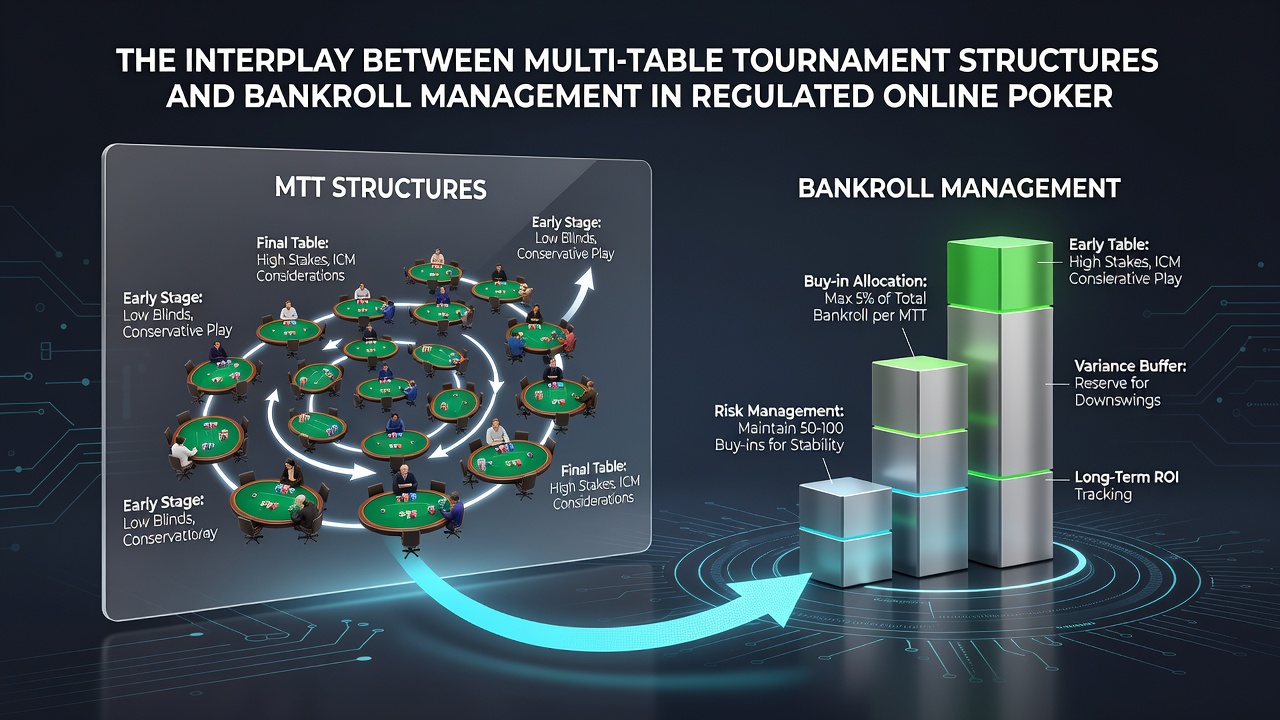
Multi-table tournaments operate under fixed schedules of blind increases and payout distributions that directly influence the variance players encounter in regulated online card rooms, and this relationship shapes how bankroll allocation gets determined across different jurisdictions.
Tournament Structures Define Variance Levels
Regulated platforms in markets such as New Jersey and Pennsylvania maintain standardized multi-table formats where blind levels advance every 10 to 15 minutes in most online events, creating compressed decision windows compared with live equivalents. Data from the New Jersey Division of Gaming Enforcement shows that average field sizes for $50 buy-in tournaments reached 1,200 entrants during the second quarter of 2026, which extends the number of hands required to reach the money and amplifies short-term swings.
Structures with slower blind progression and deeper starting stacks reduce the frequency of all-in confrontations early on, whereas turbo formats accelerate elimination rates and produce steeper payout jumps at the final tables. Observers note that these mechanical differences alter the survival curves that bankroll models rely upon when calculating required reserves.
Bankroll Allocation Formulas Adjust to Structure Parameters
Industry reports indicate that many regulated operators publish recommended bankroll guidelines ranging from 50 to 150 buy-ins for multi-table tournaments, with the higher end applied to events featuring rapid blind escalation or large fields. A study released by the University of Nevada, Reno Gaming Research Center in March 2026 examined 18 months of anonymized data from licensed sites and found that players maintaining at least 80 buy-ins experienced 34 percent fewer forced cash-outs during downswings than those operating with 40 buy-ins.
Rebuy and add-on periods introduce additional layers, because the effective buy-in can double or triple within the first hour. Platforms licensed by the Malta Gaming Authority require operators to display total cost ranges clearly, allowing players to model the maximum exposure before registration closes.
Regulatory Requirements Influence Reserve Policies
Canadian provincial regulators, including the Alcohol and Gaming Commission of Ontario, mandate that licensed poker rooms display real-time bankroll warnings when a player's session balance falls below preset thresholds relative to open tournament entries. Similar rules took effect in several Australian states in August 2026, requiring operators to pause additional registrations once available funds drop beneath a calculated multiple of the largest remaining buy-in.
These interventions create external checkpoints that interact with internal bankroll strategies, because players must now account for both mathematical variance and regulatory lockouts when deciding how many simultaneous tables to enter.
Simultaneous Table Management and Liquidity Demands
Multi-tabling in regulated environments carries explicit session limits in some jurisdictions, with New Jersey capping concurrent tournament entries at eight per player on most licensed networks. Each open table consumes a portion of the bankroll that remains unavailable until completion or elimination, so the total reserve must cover the sum of all active buy-ins plus a buffer calibrated to the longest expected duration of the slowest structure.
Payment processing rules add another variable: funds from tournament cashes typically clear within 24 hours on regulated sites, yet pending withdrawals cannot be redeployed until verification completes. This delay window becomes relevant when a player registers for a series of events scheduled across consecutive days.
Data Patterns from Mid-2026 Operations
Aggregate figures compiled by the European Gaming and Betting Association for the period ending July 2026 revealed that average bankroll utilization rates in multi-table tournaments rose 12 percent year-over-year, coinciding with an increase in overlay-heavy guaranteed prize pools. Players who adjusted their entry sizing to keep total exposure below 8 percent of liquid reserves recorded lower rates of involuntary breaks from play.
These measurements reflect structural factors such as payout percentages and blind acceleration rather than individual skill levels, underscoring the mechanical link between format design and capital requirements.
Conclusion
Regulated online card rooms embed tournament structure parameters directly into the risk calculations that govern bankroll management, with blind schedules, field sizes, rebuy mechanics, and jurisdictional reserve rules all contributing measurable effects. The data collected through 2026 demonstrates that adjustments to any single element shift the reserve multiples needed to sustain participation across multiple events without interruption.